
A truck driver pulled over on the 401 near Milton usually thinks about one thing first: the fine. A couple of hundred dollars, maybe a bit more once the victim surcharge is added. Pay it online, get back on the road, deliver the load.
That logic works for a weekend driver in a sedan. It falls apart for anyone driving a commercial motor vehicle in Ontario. When a commercial driver is convicted, the conviction lands in two places at once. It goes on the driver’s own record, and it goes on the carrier’s Commercial Vehicle Operator’s Registration, better known as the CVOR. That second record is the one that can quietly decide whether a trucking business keeps running.
Who the system covers
Ontario requires a CVOR certificate for trucks with a gross weight or registered gross weight over 4,500 kilograms, along with buses and certain other commercial vehicles. That net catches far more than the big long-haul fleets. A landscaping company with two dump trucks has a CVOR. So does the owner-operator hauling gravel out of Caledon, and the regional flatbed outfit running steel to Hamilton. Every one of them carries a safety record that the Ministry of Transportation reviews on an ongoing basis.
How the points add up
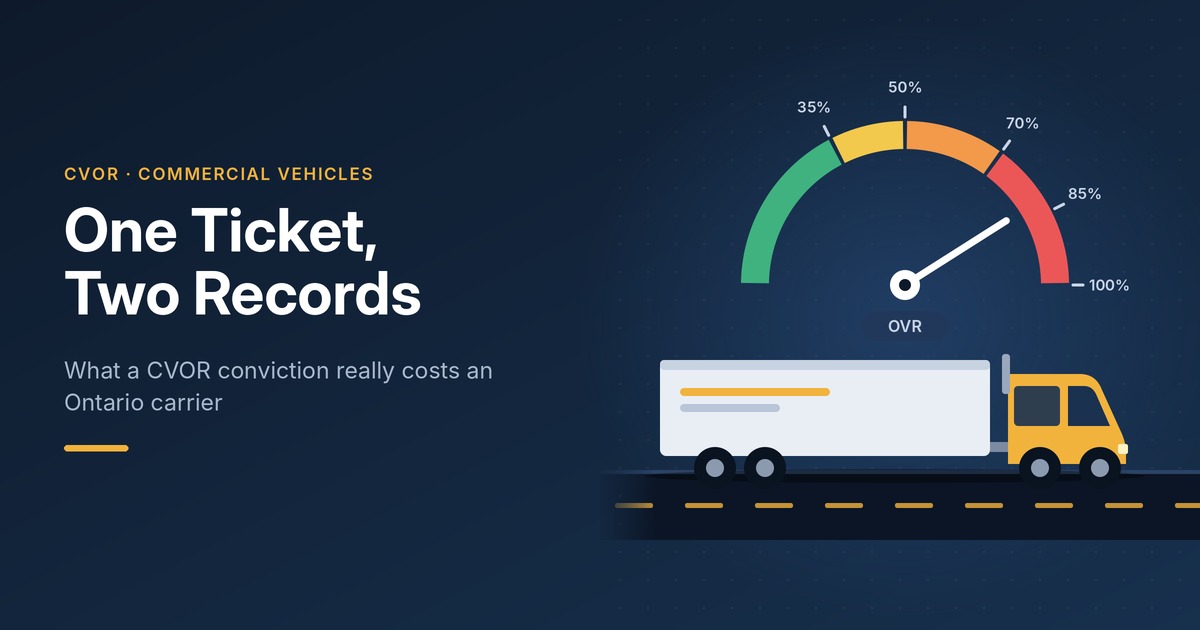
The ministry tracks three kinds of events on a carrier’s record: collisions, convictions and roadside inspections. Each event is given a point value, and those points are compared against a threshold set for that particular operator. The threshold depends on fleet size, the number of drivers and the kilometres travelled. The result is the Overall Violation Rate, shown as a percentage of the threshold.
Two features make this system harsher than most people expect. First, collisions and convictions count twice as much as inspection results. A driver can sail through a dozen roadside inspections and still damage the company’s file badly with one moving-violation conviction. Second, the record runs on a 24-month sliding window. A conviction entered this spring will still be pushing the percentage up the year after next.
Size matters too. Because thresholds scale with the operation, a small carrier has much less room than a large one. Three convictions that barely register for a 200-truck fleet can move a three-truck business a long way up the scale.
What happens as the percentage climbs
The ministry’s own reference guide for operators sets out the intervention bands:
- At 35% of the threshold, the carrier may receive a warning letter.
- From 50%, the ministry may decide a facility audit is needed, with inspectors working through driver files, maintenance records and hours-of-service documents.
- At 70%, the carrier’s safety rating drops to Conditional, with or without an audit.
- At 85%, senior management may be called to an interview with a ministry official and required to commit to an action plan.
- At 100% or more, the CVOR certificate can be suspended or cancelled, and the carrier has to explain to the Deputy Registrar why it should keep its operating privileges.
The safety rating is not private. Insurers, banks and shippers can look it up for free. A Conditional rating is a problem the people who send you freight and renew your insurance can see for themselves.
Why paying the ticket is often the expensive choice
Paying a provincial offence ticket is a guilty plea. The conviction is entered, and it flows through to the driver’s record and the operator’s record. There is no later stage where anyone asks whether the effect on the CVOR is proportionate.
Many everyday charges carry the highest CVOR value available. Speeding 21 km/h or more over the limit, failing to yield, a red light and distracted driving are each worth five CVOR points. Equipment defects add their own points on top.
Picture a small fleet over two years. One driver is convicted of an unsafe lane change in March. Another is convicted of following too closely in June. A third truck is involved in a collision that fall. None of those events feels like a crisis when it happens. Inside the same 24-month window, though, they can pull a small carrier toward warning-letter and audit territory before anyone in the office has looked at the numbers.
Owner-operators take the hit twice. The conviction adds demerit points to their personal licence and points to their CVOR, and either one can raise insurance costs at renewal.
What a proper challenge can achieve
Fighting a CVOR ticket is rarely about a clever loophole. It is careful, methodical work. A representative will usually start by requesting disclosure: the officer’s notes, any speed-measuring device records, scale tickets and calibration documents for weight charges, and the full inspection report for equipment charges. Those documents often show whether the section charged actually fits what happened, and whether the right party was named.
From there, the options become clearer. Some charges do not hold up once the evidence is examined. In others, a prosecutor may agree to resolve the matter with a lesser offence that carries fewer points. And when a case goes to trial, the prosecution still has to prove every element of the charge. Because the record runs on a two-year window, even reducing the points on one conviction can keep a carrier out of the next intervention band.
Timing matters. An Ontario offence notice gives you 15 days to choose how to respond. If you let that deadline pass, you can be convicted without a hearing, and the points arrive anyway.
For a clear breakdown of how common charges translate into CVOR points, Traffic Paralegal Services, a licensed paralegal firm based in Caledon East that represents commercial drivers and carriers across Ontario, keeps a detailed guide at https://www.trafficparalegalservices.com/cvor-tickets/ that is worth reading before you decide anything about a commercial ticket.
A short checklist for drivers and fleet managers
- Don’t pay a commercial ticket until someone has checked what it will do to the CVOR.
- Send the ticket to whoever handles safety and compliance the same day it is issued.
- Pull the carrier’s CVOR record and confirm the fleet size and kilometre figures are accurate, since they set your threshold.
- Preserve evidence early: dashcam footage, ELD data, inspection reports, scale tickets and photos of the scene or equipment.
- Talk to someone who handles commercial charges regularly, not just general traffic tickets.
The long memory of the CVOR
The CVOR is a system with a long memory and very little patience for small operators who ignore it. A single roadside stop is really a two-year decision for the business behind the truck. Treat every commercial ticket that way, and get it reviewed before the 15 days run out.


